Wednesday, 14 October 2015

​FCA spokeswoman Jodi Tinson and UAW spokesman Brian Rothenberg declined to comment.


Details leaking out ahead of a union leadership briefing on Friday have been confirmed by sources familiar with the proposal that was reached just prior to the Wednesday night deadline that averted a potential strike by 40,000 unionized workers.
The agreement addresses some of the main areas of contention in the original tentative agreement reached Sept. 15 which was rejected by 65% of the membership.
Highlights of the deal:​
•Entry-level workers would reach the same $29 an hour base wage as their senior colleagues over eight years; a 53% increase from the $19 an hour top wage now.
•Workers hired before 2007 still get a 3% raises in the first and third year and two lump sum payments


•All workers still get a $3,000 signing bonus when the agreement is ratified.
•Profit sharing, based on hours worked, will be paid equally to all employees -- eliminating the past proposal of paying entry-level workers more.
•Cost of living allowance is not reinstated.
•Health care costs do not increase, with the exception of an emergency room charge if the visit is not an emergency.
•Some future plant, product and employment plans will be shared with workers
​FCA spokeswoman Jodi Tinson and UAW spokesman Brian Rothenberg declined to comment.
UAW President Dennis Williams told members in a post just after midnight that the new agreement contains "significant gains." He said, "we heard from our members and went back to FCA to strengthen their contract."
A key area was addressing the inequity of having two workers doing the same work but paying an employee hired before 2007 twice as much as a newer hire.
About 45% of FCA workers are lower tier and they sought a clear path to the top wage level.
The proposal gets a new hire to the new $29 an hour base wage at the end of eight years. It would be a shorter grow-in period for workers who already have some seniority with the company. The previous agreement increased their rate to $25 an hour over four years.

Tuesday, 13 October 2015

Despite modest gains towards pay equality in recent years

California passed this October a pay equity law — one of the first of its kind — that expands the grounds on which women can challenge gender discrimination in the workplace. Similar legislation at the national level has been unsuccessful. Despite modest gains towards pay equality in recent years, women are still paid less than 80 cents for every dollar a man earns. In some states, the gaps are far worse.
24/7 Wall St. reviewed a range of economic, leadership, and health factors to identify the 10 worst states for women. Utah trails the nation as the state with the worst gender gaps, while Oregon has the smallest gender gaps overall.

Nationwide, a typical female earns $38,941 annually, nearly $10,000 less than the median annual salary of a typical male of $48,745. In no state do women have higher incomes than men. Heidi Hartmann, president of the Institute for Women’s Policy Research, noted that even millennial women, who tend to be more educated than their male peers, are paid less on average than millennial men.
According to Hartmann, job discrimination is one of the primary drivers of gender inequality, and this partly explains the differences between states. Women are far more likely to work in service oriented, health, financial, or education-related fields than in many other industries. In states where these fields dominate, “women will do better than they do in states that might be heavily dominated by mining or manufacturing or other forms of resource extraction like agriculture and forestry,” Hartmann said.

Sunday, 11 October 2015

The largest regional trade agreement in history involves the United States and 11 countries in the Asia Pacifi


The largest regional trade agreement in history involves the United States and 11 countries in the Asia Pacific and the Americas, which collectively represent about 40% of world GDP and around a quarter of global exports.
More than five years in the making, the TPP, as it is commonly referred to, was finalized on Monday, but it still needs the approval of lawmakers in member countries, including the U.S. Congress.
Given the importance of the accord, which is designed to boost cross-border trade and investment among member countries and, ultimately, economic growth, it might seem strange that China, the world’s second largest economy and biggest trading nation on the planet, has been left out.
While a lot of the details of the deal are still secret, the TPP is clearly more than just a free trade agreement. In addition to slashing or eliminating 98% of tariffs on thousands of goods including dairy, beef, sugar, cars, tractors and chemicals, it also establishes common rules and regulations for trade and investment across member countries as well as external tribunals to sort out disputes.
TPP member states will include the United States, Japan, Malaysia, Vietnam, Singapore, Brunei, Australia, New Zealand, Canada, Mexico, Chile and Peru. More countries are expected to join the exclusive trading club, but given the tough membership rules, China is not expected to sign up any time soon.
Perhaps never.

Excluding China has been widely interpreted as an attempt by the United States to curtail Beijing’s growing political and economic might in the Asia Pacific region, and some experts have described it as a “terrible mistake.”
But does Beijing really care? Possibly not as much as you might think.
For starters, China doesn’t need to belong to the TPP to enjoy some of the perks that come with being a member.
Beijing already has free trade agreements with more than half of the TPP countries, including Australia, New Zealand, Chile, Peru, Singapore, Brunei and Vietnam, and it can exploit those arrangements to minimize or avoid import duties that would normally apply to made-in-China products.
Felipe Caro and Christopher Tang of UCLA's Anderson School of Management explained in Fortune magazine this week how that could work.
“To satisfy certain country­-of-­origin conditions stipulated in TPP, China can manage the supply chain operations of cotton shirts by importing cotton from Pakistan (via its existing free trade agreement with China) and conduct 'upstream' operations, such as fabric design, knitting and dyeing at home.
"Then China can ship the fabric to Vietnam (via an existing free trade agreement with China). At the same time, Japan can ship the buttons to Vietnam (via the TPP). Vietnam can perform 'downstream' operations (sewing) and then ship the finished shirts via TPP agreement to Australia, Japan and the United States, cutting off the 5%, 10.9% and 16.5% import duties that would have applied if China had dealt directly with these countries.”
And China clearly doesn’t require the TPP to enhance its already sizeable influence in the world.

Saturday, 10 October 2015

Medical emergencies are rare, but hardly unprecedented in commercial flights.

Medical emergencies are rare, but hardly unprecedented in commercial flights.
It's far less common when they involve the plane's pilot -- and that pilot dies.
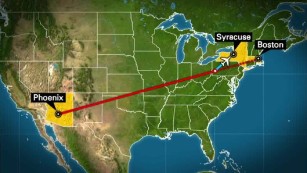
That's what happened Monday on an American Airlines flight between Phoenix and Boston.
Captain Michael Johnston, 57, was piloting the plane when he fell ill somewhere en route. The co-pilot landed the jet safely.
Crew members "took extraordinary care of Mike, each other and our customers," airline CEO Doug Parker said in a statement sent to employees.
"We couldn't be more proud of the teamwork this crew showed during an extremely difficult time."
American Airlines pilot dies mid-flight, co-pilot lands

American Airlines pilot dies mid-flight, co-pilot lands 02:17
An autopsy and preliminary toxicology tests "showed that the death was the result of natural diseases," the Onondaga County, New York, medical examiner's office said -- without offering specifics.
Johnston's wife, BJ, told CNN affiliate KUTV-TV that her husband had a double bypass surgery in 2006. She said she was told he likely died of a heart attack.
"Whatever happened in the cockpit, none of us will know," passenger Frank Cacciola told CNN affiliate WCVB-TV.
Cacciola was among the 147 passengers and five crew members aboard Flight 550 when it took off around midnight. Their Airbus A320 plane was being operated by U.S. Airways, which is part of American.
After the pilot fell ill, the flight was diverted to Syracuse, New York.

Friday, 9 October 2015

The blue-chip Dow was up about 60 points, or 0.3%, at 11 a.m. The Dow is in rally mode. It is riding a five-session win streak


The Dow, which was trading higher in morning trading, looks to extend its rebound rally off its recent correction lows to six sessions as stocks continue to head higher after the release of minutes of the Federal Reserve's meeting last month lowered investor expectations for an interest rate hike this year.
The blue-chip Dow was up about 60 points, or 0.3%, at 11 a.m. The Dow is in rally mode. It is riding a five-session win streak — its longest since December. And it is up 578 points, or 3.5%, for the week, putting it on track for its best weekly advance since a nearly 660-point, 3.8%, run-up in early February.
Also higher was the broader Standard & Poor's 500, which is up 0.3%. The Nasdaq composite is up 0.6%.
U.S.-producted crude was also higher, at one point climbing above the key $50 a barrel level.
Stocks also rallied overseas, putting global shares on track for their best week since 2011, according to Reuters. At midday in Europe, the MSCI world equity index was up 0.8%, its eighth up day in a row, putting the index up 4.5% on the week, its best performance since late 2011, Reuters reported.
Wall Street is enjoying a relief rally after the U.S. stock market suffered its first 10% price correrction in four years in late summer. The renewed buying has been driven by a belief that the Fed will hold off on rate hikes until next year due to fears about global tumult and still-weak inflation. Wall Street's interpretation of the September Fed meeting minutes, which were released Thursday, is that the Fed will keep rates "lower for longer."

The delay in rate hikes has translated into a weaker dollar, which has given commodities, such as hard-hit oil, a big boost. A weaker dollar also makes U.S. products more affordable abroad, which benefits sales and earnings of big U.S. multinationals.

Friday, 2 October 2015

Britain slips down global competitiveness league table


Britain has slipped down a place in the global competitiveness rankings, despite cementing its status as the “epicentre” of Europe’s start-up scene, according to the World Economic Forum.
The WEF’s flagship report said Britain’s ability to draw top talent from abroad through its universities and burgeoning digital economy meant the country could “count on a well educated workforce”.
“The country has created a good set of conditions for its vibrant service sector to develop and for London to become the epicenter of the European tech and start-up scene,” the WEF said.
However, its global competitiveness report said Britain’s broad improvement this year was smaller than its peers, and the country slipped down a place to 10th in 2015.
The WEF said poor maths and science skills remained a “long-term problem” for the UK, while Britain’s stubbornly high deficit and debt ratios placed it 108th out of 140 countries.

Switzerland, which was ranked the most competitive country for the seventh consecutive year, was praised by the WEF for its world-class research institutions and high spending on research and development.
Singapore was ranked the second most competitive country, followed by the US and Germany, while Sweden’s top education system and high rank for innovation helped it to leapfrog the UK into ninth place.
However, the report said there were “worrying signs” that a “new normal” of lower growth was emerging.
The UK performed better than many other advanced economies
“Seven years after the global financial crisis, the world economy is evolving against the background of the “new normal” of lower economic growth, lower productivity growth, and high unemployment.
"Although overall prospects remain positive, growth is expected to remain below the levels recorded in previous decades in most developed economies and in many emerging markets,” the report said.
The WEF urged policymakers to implement “productivity-enhancing reforms” to avoid low growth becoming entrenched.
A spokesman for the UK government said: “Today’s figures show that the UK remains one of the top 10 best places in the world to start and grow a business. Our focus is firmly fixed on increasing productivity.”

Thursday, 1 October 2015

VW scandal: 1.2m UK vehicles affected

Volkswagen has announced that nearly 1.2 million of its vehicles sold in the UK are fitted with the software behind the emissions scandal.
It includes diesel-powered cars with the VW brand, Audi, Seat and Skoda as well as VW commercial vehicles.
In the next few days the company will give the vehicle identification numbers to retailers as well as coming up with a process for owners to check if their vehicles are affected.
VW will then start contacting owners.
The company stressed that all the vehicles are still safe and roadworthy.
VW plans to present its plans for resolving the problems with the affected vehicles to regulators next month.
The specific number of vehicles affected under each brand are:
  • Volkswagen cars 508,276
  • Audi 393,450
  • Seat 76,773
  • Skoda 131,569
  • VW commercial vehicles 79,838
  • Total 1,189,906

Analysis: John Moylan, industry correspondent

The UK was always likely to have substantial numbers of the diesel cars involved in this scandal.
It has long been the biggest new car market in the EU after Germany. Forecourt incentives, including the use of innovative financing deals, pushed new car sales to a 10-year high in 2014.
And around half of all new cars bought here are diesels.
In 2001 Labour introduced a graded system for vehicle excise duty which penalised vehicles that emitted higher levels of carbon dioxide (CO2).
Diesels typically emit less CO2 than equivalent petrol cars. So many consumers have switched to diesel from petrol believing they could save money and go green.
There's probably another factor too.
British consumers like quality brands and are prepared to pay for them. More than 900,000 of the almost 1.2m vehicles involved in the UK are VW and Audi branded models.
The emissions scandal began in the US when regulators discovered that certain vehicles made by Volkswagen were fitted with software that would make their diesel engines operate differently when they sensed that the car was being tested.It meant that the vehicles emitted considerably more pollutants in real world driving conditions than they had in testing.
As a result of the scandal, VW chief executive Martin Winterkorn resigned and was replaced by former Porsche boss Matthias Mueller.
The carmaker has so far set aside €6.5bn to cover the costs of the scandal.
It has said that 11 million vehicles worldwide are affected, of which 500,000 were in the US

 
Design by Free WordPress Themes | Bloggerized by Lasantha - Premium Blogger Themes | Colgate Coupons